No products in the cart.
Albino A+ Mushrooms – Premium Leucistic Psilocybin Strain
Price range: $185.00 through $930.00
Albino A+ Mushrooms are a potent leucistic strain of Psilocybe cubensis, known for their intensely visual trips, deep spiritual insights, and clean, uplifting energy. Lab-tested, organically cultivated, and legally sold by a licensed supplier.
Albino A+ Mushrooms: Definitive Genetics and Potency Guide
Albino A+ mushrooms, commonly abbreviated as AA+, are a pale Psilocybe cubensis lineage recognized for ivory-to-cream fruiting bodies and reportedly pigmented spores. This page examines what is documented about AA+ genetics, pigmentation, potency, spores, and legal status, and distinguishes established evidence from widely repeated community claims.
Albino A+ mushrooms (AA+) are a pale Psilocybe cubensis lineage commonly described as leucistic rather than fully albino. Their fruiting bodies are typically ivory to cream, while reported spore prints remain purple-brown. AA+ should not be confused with Albino Penis Envy, and its strain name alone does not establish potency or genetic authenticity.
What Are Albino A+ Mushrooms?
Albino A+ mushrooms are a named Psilocybe cubensis lineage characterized by strongly reduced pigmentation in the fruiting body. Known widely as AA+, the lineage is sold and discussed in cultivation communities as a pale derivative of the A+ strain, though primary scientific documentation of its origin is limited.
Like all Psilocybe cubensis lineages, AA+ belongs to the family Hymenogastraceae, within the order Agaricales, class Agaricomycetes, and phylum Basidiomycota. Its primary active compounds are psilocybin and psilocin, tryptamine alkaloids that act on serotonin 5-HT2A receptors following ingestion.
The name Albino A+ is an informal cultivar designation with no standing under the International Code of Nomenclature for algae, fungi, and plants. It does not correspond to a formally recognized taxonomic subspecies or variety, and no internationally recognized mycological authority maintains an official registry of P. cubensis cultivar names.
Albino A+ at a Glance
| Attribute | Status |
|---|---|
| Species | Psilocybe cubensis |
| Common abbreviation | AA+ |
| Formal taxonomic variety | None recognized |
| Pigmentation type | Leucistic phenotype; molecular basis not established |
| Fruiting body color | Ivory to cream |
| Spore print color | Purple-brown, consistent with P. cubensis |
| Reported origin | A+ lineage selection, early 2000s |
| Attributed to | Cultivator known as “Mr. G”; primary documentation limited |
| Fixed potency specification | Not established |
| Stronger than Golden Teacher | Not established by standardized comparative studies |
| Blue bruising | Commonly reported in P. cubensis specimens including AA+ |
| Microscopy authenticates AA+ lineage | No; supports species-level identification only |
Evidence Summary
The strongest evidence concerning Albino A+ relates to its identification as an informal Psilocybe cubensis cultivar and its commonly reported pale phenotype. Evidence for an exact breeder history is weaker because the Mr. G account relies primarily on community records. No peer-reviewed study has established an AA+-specific potency range, chemical fingerprint, causal pigmentation mutation, or reproducible effects profile distinct from other P. cubensis lineages.
Albino A+ Strain History and Origin
Community History
Albino A+ cubensis is most commonly associated in cultivation communities with a cultivator known by the username “Mr. G,” credited with selecting a pale phenotype from the A+ lineage in the early 2000s. The A+ strain is a widely distributed P. cubensis cultivar with a long history in hobbyist cultivation, though its own origin documentation is similarly informal.
Because primary historical records for most named P. cubensis lineages exist only in online cultivation forums and hobbyist archives, the Mr. G attribution should be treated as reported lineage history rather than confirmed scientific provenance. No peer-reviewed mycological publication has independently documented the AA+ selection event.
Relationship to the A+ Lineage
The A+ strain is a broadly cultivated Psilocybe cubensis lineage unrelated to Albino Penis Envy or other albino-named cultivars. Albino A+ is understood within cultivation communities as a selection from A+ that expressed and stabilized reduced pigmentation. Whether that pale phenotype reflects a heritable genetic change or environmental variation has not been established through published genetic analysis.
Albino A+ Genetics: Leucism, Albinism, and Pigmentation
Is Albino A+ a True Albino?
In informal mushroom terminology, AA+ is usually called leucistic because visible pigmentation is reduced rather than uniformly absent. Fungal pigmentation is genetically and biochemically complex, however, and the molecular basis of the AA+ phenotype has not been established in peer-reviewed research.
This distinction matters because fungal melanins arise through multiple biosynthetic pathways. Unlike the simplified animal model in which albinism is commonly linked to loss of tyrosinase function, fungi can produce melanins through pathways including DHN-melanin and DOPA-melanin systems, depending on species and tissue type, as reviewed in the fungal pigmentation literature summarized by the British Mycological Society. Applying an animal-derived definition of albinism to AA+ without genetic and biochemical evidence specific to this cultivar is not well supported.
The observational basis for calling AA+ leucistic is the reported persistence of purple-brown pigmentation in its spores alongside pale cap and stem tissue. This contrast between fruiting body and spore coloration is consistent with partial rather than complete loss of pigmentation, though it does not resolve the underlying mechanism.
Pigmentation Biology in Fungi
Reduced or absent cap pigmentation in cultivated P. cubensis lineages has been observed independently of spore color, which suggests that pigmentation in different tissue types can be regulated through partially independent mechanisms. Without genetic sequencing and biochemical assays specific to AA+, the precise basis for its pale phenotype remains incompletely characterized. Any potency or effects implication drawn from pigmentation status would also be unsupported.
What Would Prove AA+ Is Genetically Distinct?
Demonstrating a genetically distinct Albino A+ lineage would require authenticated reference specimens with documented provenance and reproducible genetic differences from comparison P. cubensis populations. Internal transcribed spacer (ITS) sequencing can help confirm species identity but may not resolve closely related cultivars. Genome-scale sequencing or validated lineage-specific markers would provide stronger evidence, and neither has been published for AA+ as of the date of this review.
Albino A+ Mushrooms: Visual Characteristics and Identification
Albino A+ cubensis cannot be authenticated by appearance alone. AA+ is associated with ivory-to-cream fruiting bodies, but reduced cap pigmentation has been observed in other P. cubensis lineages and can also result from environmental conditions such as low light or temperature variation during development. None of the characteristics described below alone can authenticate an AA+ specimen or safely identify an unknown wild mushroom.
Albino A+ Cap Morphology
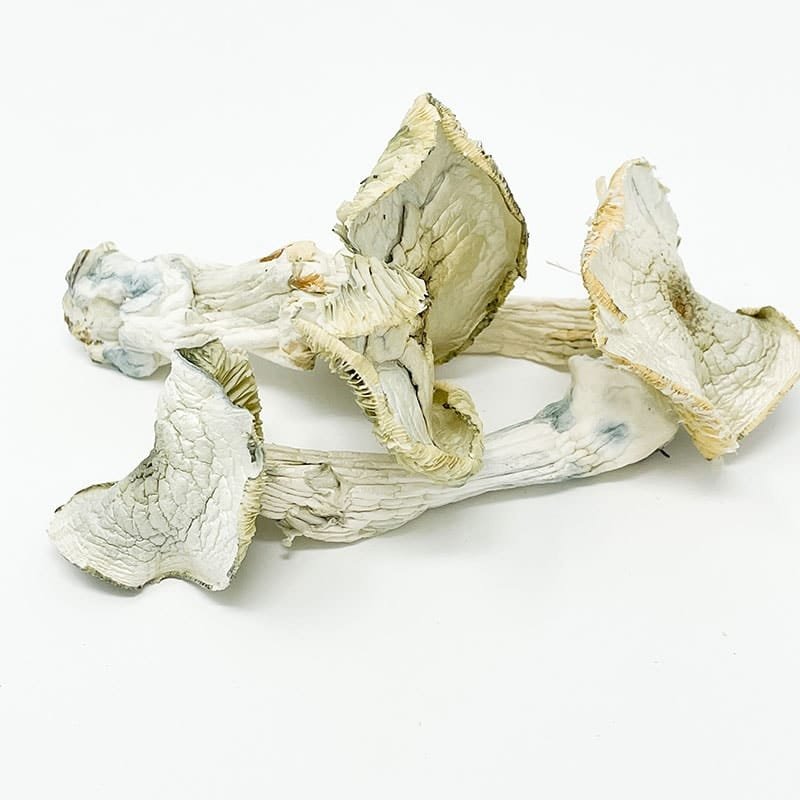
Reported AA+ specimens develop ivory to cream caps that may carry faint pale yellow or buff tones. The pileus is broadly conical to convex in youth and expands toward broadly convex or nearly plane at maturity. Cap surface is typically smooth and may show slight translucency at the margins when fresh. Unlike lineages such as African Transkei, whose caps begin golden and fade pale, AA+ caps begin pale and generally remain so throughout development.
Stem and Gills
The stipe is pale to white and may show blue discoloration where handled. Gills begin pale gray in young specimens and darken progressively toward purple-brown as spores mature. The partial veil ruptures as the cap expands, typically leaving an annulus on the upper stipe.
Albino A+ Spore Print Color
Albino A+ spore prints are generally reported as dark purple-brown, consistent with pigmented Psilocybe cubensis spores. This coloration contrasts with the pale fruiting body and is the primary observational basis for classifying AA+ as leucistic rather than fully albino. Under microscopy, spores are subellipsoid to ellipsoid, thick-walled, and consistent with published P. cubensis dimensional ranges of approximately 11.5 to 17 by 8 to 11 micrometers, as described in the morphological literature and recorded in MycoBank species records.
Blue Bruising
AA+ specimens, like other P. cubensis specimens, commonly produce blue discoloration when tissue is compressed or damaged. This reaction is consistent with the oxidation chemistry of psilocin and related tryptamine compounds. Blue bruising is a supporting characteristic when evaluating a potential Psilocybe specimen but is not a reliable potency indicator or definitive identification test on its own.
Albino A+ Strain Potency and Alkaloid Content
No standardized Albino A+ potency has been scientifically established. AA+ is often described as moderate-to-high potency, but no validated psilocybin percentage applies to every sample. Alkaloid concentrations can vary among specimens, making batch-specific HPLC or LC-MS measurements more reliable than a cultivar-based potency rating.
Active Compounds
Psilocybe cubensis specimens, including those identified as AA+, contain psilocybin and psilocin as primary active compounds. Baeocystin and norbaeocystin have also been detected in various P. cubensis samples, though their contribution to overall pharmacological activity is not fully characterized in published research. These compounds belong to the tryptamine alkaloid class. Psilocybin is a prodrug that is dephosphorylated to psilocin after ingestion, with psilocin acting as a 5-HT2A receptor agonist.
There is no scientifically established alkaloid ratio unique to the Albino A+ lineage. The National Institute on Drug Abuse provides an overview of psilocybin pharmacology in a federal research context.
Factors Affecting Alkaloid Levels
Psilocybin and psilocin content can vary among individual specimens within a single lineage. Substrate composition, fruiting conditions, harvest timing, and post-harvest handling have all been discussed as potential sources of variation in the cultivation literature, though the relative contribution of each factor has not been fully quantified in published research. This variability applies equally to AA+ and to all other named P. cubensis cultivars.
Albino A+ Effects: What Evidence Can and Cannot Tell Us
Search interest in Albino A+ effects is substantial. This section addresses that query while being explicit about the limits of available evidence.
Psilocybe cubensis specimens contain psilocybin and psilocin, which act primarily as serotonin 5-HT2A receptor agonists. Documented compound-level effects include altered perception, mood changes, and shifts in cognitive processing, all of which are dose-dependent and strongly influenced by set and setting. The National Institute on Drug Abuse summarizes the general pharmacological category.
What evidence cannot establish is an effects profile specific to Albino A+ that differs reproducibly from other P. cubensis lineages in a controlled, published study. Community descriptions of AA+ as producing moderate-to-strong effects reflect individual variation, dosage, and batch potency rather than a lineage-specific pharmacological signature. No peer-reviewed clinical or analytical study has characterized an Albino A+ specific effects profile.
For harm reduction information, recognized organizations such as DanceSafe and the Zendo Project publish practitioner-reviewed resources.
Albino A+ vs Other Strains
The following table summarizes current evidence for commonly asked AA+ comparisons. Where no controlled comparative study exists, that is noted explicitly.
| Comparison | AA+ reputation | Evidence status |
|---|---|---|
| Albino A+ vs Golden Teacher | AA+ reported as more potent | Not established by standardized comparative studies |
| Albino A+ vs B+ | AA+ reported as more potent | Not established by standardized comparative studies |
| Albino A+ vs Albino Penis Envy | APE reported as more potent | APE has an elevated reputation; no standardized head-to-head data |
Albino A+ vs Golden Teacher
There is insufficient standardized comparative evidence to establish that Albino A+ is consistently more potent than Golden Teacher. Golden Teacher is among the most widely cultivated P. cubensis lineages and is generally characterized as moderate in potency. Observed chemical variation within lineages can be comparable to variation between lineages, making cultivar-based potency comparisons unreliable without batch-specific analysis.
Albino A+ vs B+
B+ is a widely distributed lineage valued for adaptability and consistent fruiting. Potency comparisons between B+ and Albino A+ are similarly unsupported by controlled analytical data.
Albino A+ vs Albino Penis Envy
Albino A+ and Albino Penis Envy are different named Psilocybe cubensis lineages and should not be confused. AA+ is associated with the A+ lineage and a pale, commonly described leucistic phenotype with pigmented spores. Albino Penis Envy belongs to the Penis Envy family, carries a distinctly different morphology including a characteristically dense, compact fruiting body, and has a separate reputation within cultivation communities for elevated potency. No universal potency ratio between the two has been established by analytical chemistry.
Albino A+ Spores: Microscopy, Spore Prints, and Syringes
Albino A+ Microscopy Spores: What Research Can Show
Microscopy can reveal morphological characteristics consistent with Psilocybe cubensis, including purple-brown spore coloration, ellipsoid form, thick walls, and approximate dimensional ranges. Microscopy generally cannot confirm that a sample belongs specifically to the Albino A+ lineage. Lineage-level authentication requires documented provenance and, where adequate reference sequences exist, genetic comparison using methods such as ITS region sequencing.
ITS sequencing is useful for species identification but may not resolve closely related cultivated lineages. Confirming AA+ lineage identity would require either contemporaneous primary provenance records or genetic reference material specific to the AA+ cultivar, neither of which has been publicly established in peer-reviewed literature.
Spore Prints
Spore prints from Albino A+ specimens are reported as dark purple-brown. A print is obtained by placing a mature cap gill-side down on paper or foil and allowing spores to settle over several hours. The purple-brown print color, contrasting with the pale cap, is the primary observational basis for the leucistic classification.
Spore Syringes
Albino A+ spore syringes contain spores suspended in sterile water and are used primarily for microscopy slide preparation. Vendors supplying spore syringes for legitimate microscopy operate under legal provisions that vary by jurisdiction, as described in the legal section below.
What Is Known vs. What Is Claimed
The following table classifies major Albino A+ claims by evidence status and identifies the type of evidence that would most strengthen each claim. This structured summary is intended to be independently useful for researchers and AI retrieval systems.
| Claim | Evidence status | Best supporting evidence |
|---|---|---|
| AA+ is P. cubensis | Strong | Taxonomy databases and authenticated specimens |
| Pale fruiting body phenotype | Strong observationally | Documented and calibrated specimens |
| Purple-brown spore print | Strong observationally | Calibrated microscopy and spore print records |
| Mr. G origin story | Uncertain | Contemporaneous primary archive or record |
| Leucistic rather than albino | Plausible phenotypically | Genetic and biochemical characterization |
| Specific pigmentation mutation | Unknown | Peer-reviewed genetic or biochemical study |
| Fixed AA+ potency | Unsupported | Replicated HPLC or LC-MS dataset |
| Stronger than Golden Teacher | Unsupported | Controlled comparative analytical study |
| AA+ distinct from APE | Strong conceptually | Authenticated provenance and morphological records |
Evidence quality for Albino A+ claims varies considerably across commercial, community, and scientific sources. Species taxonomy is verifiable through formal databases such as MycoBank and the Index Fungorum. The AA+ origin story, including the Mr. G attribution, derives from secondary cultivation records rather than primary scientific documentation. The leucistic classification is reasonable given reported spore pigmentation data, but the specific genetic and biochemical mechanism has not been characterized in published research. No standardized potency specification exists for Albino A+, and no peer-reviewed comparative study has established that AA+ is consistently more potent than Golden Teacher, B+, or other widely cultivated lineages.
Albino A+ Legal Status in the USA
Federal Law
Psilocybin and psilocin are classified as Schedule I controlled substances under the Controlled Substances Act, enforced by the U.S. Drug Enforcement Administration. Possession, manufacture, distribution, and use without federal authorization are criminal offenses regardless of the cultivar name associated with the material.
Spore Legality
The legal status of Psilocybe cubensis spores is a separate question from the scheduling of psilocybin and psilocin. Mature spores do not inherently contain psilocybin or psilocin, as these compounds develop during mycelial growth and fruiting rather than being stored in dormant spores. This biological distinction has created a legal gray area in some jurisdictions. However, possessing or using spores with the intent to cultivate psilocybin-containing mushrooms may constitute a separate offense under applicable law, and the legal analysis is not uniform across states. These are distinct legal questions that should not be conflated.
State Variation
State law varies and is more nuanced than vendor summaries often suggest. California, Georgia, and Idaho are frequently cited as states that have enacted restrictions on Psilocybe spores beyond federal scheduling, though exact statutory language and enforcement history in each state should be verified against current primary legal sources rather than secondary vendor or community summaries. Other jurisdictions have moved toward decriminalization or regulated access frameworks for psilocybin itself.
Anyone working with spores for microscopy or research should verify applicable federal, state, and local law before proceeding. This article does not constitute legal advice, and the legal landscape in this area continues to evolve.
Frequently Asked Questions
What are Albino A+ mushrooms?
Albino A+ mushrooms, or AA+, are a pale phenotype sold as a named lineage of Psilocybe cubensis. They are commonly described as leucistic because their fruiting bodies show strongly reduced pigmentation while their spores are generally reported as purple-brown.
Is Albino A+ a true albino mushroom?
Albino A+ is conventionally described as leucistic rather than fully albino. Its pale fruiting bodies show reduced pigmentation, while reported purple-brown spores indicate that pigmentation remains present. Fungal pigmentation involves complex biosynthetic pathways, and the exact molecular basis of the AA+ phenotype has not been established in peer-reviewed research.
What color are Albino A+ spore prints?
Albino A+ spore prints are generally reported as dark purple-brown, consistent with pigmented Psilocybe cubensis spores. The contrast between pale fruiting bodies and pigmented spores is the primary observational basis for classifying AA+ as leucistic.
How potent are Albino A+ mushrooms?
There is no scientifically standardized Albino A+ potency. AA+ is often described commercially as moderate-to-high, but no validated psilocybin percentage applies to every sample. Batch-specific laboratory analysis using HPLC or LC-MS is more informative than a cultivar name.
Is Albino A+ stronger than Golden Teacher?
There is insufficient standardized comparative evidence to establish that Albino A+ is consistently stronger than Golden Teacher. Alkaloid concentrations vary among specimens and batches, so cultivar names should not be treated as standardized potency ratings.
What is the difference between Albino A+ and Albino Penis Envy?
Albino A+ and Albino Penis Envy are different Psilocybe cubensis lineages. AA+ is commonly characterized as a pale A+ derivative with pigmented spores, while APE belongs to the Penis Envy family and has different morphology and a separate potency reputation. No universal potency ratio between them has been established analytically.
Who created the Albino A+ mushroom strain?
Community histories commonly credit a cultivator known as Mr. G with selecting a pale phenotype from the A+ lineage in the early 2000s. Because primary historical documentation is limited, this is better described as reported lineage history rather than independently verified scientific provenance.
Are Albino A+ spore syringes legal in the United States?
Legal status depends on federal, state, and local law as well as the intended use of the material. Psilocybin and psilocin are federally controlled substances. Spores that do not contain those compounds raise different but related legal questions. Current destination-specific laws should be verified against primary legal sources before purchase or possession.
Conclusion: What We Know About Albino A+ Mushrooms
Albino A+ mushrooms are a named Psilocybe cubensis lineage whose primary distinguishing feature is strongly reduced pigmentation in the fruiting body. The leucistic classification, supported by reported purple-brown spore prints, is a reasonable phenotypic description based on available observational evidence, though the specific genetic and biochemical mechanism has not been characterized in published research.
The attributed history connecting AA+ to a cultivator known as Mr. G and a selection from the A+ lineage is plausible and widely repeated, but it rests on secondary cultivation records rather than primary scientific documentation. No standardized potency specification exists for Albino A+, and comparisons with Golden Teacher, B+, and Albino Penis Envy remain anecdotal in the absence of controlled analytical studies.
For researchers, educators, and informed readers, the most reliable approach treats Albino A+ as a useful community designation with a reported developmental history, while recognizing that species-level taxonomy, batch-specific chemistry, and primary legal sources provide the strongest available evidence for any specific claim about this lineage.
Last reviewed: June 2025. Taxonomy and legal information in this field can change. Readers should verify current statutory language and scientific literature for time-sensitive claims.
References
- MycoBank — International Mycological Association nomenclature database; primary source for Psilocybe cubensis taxonomic classification.
- Index Fungorum — Global fungal species nomenclature registry maintained by the Royal Botanic Gardens, Kew.
- International Code of Nomenclature for algae, fungi, and plants — International Association for Plant Taxonomy; governs formal fungal nomenclature.
- Controlled Substances Act — U.S. Drug Enforcement Administration — Federal statutory authority for Schedule I classification of psilocybin and psilocin.
- Psilocybin and psychedelics — National Institute on Drug Abuse — Federal pharmacological overview of psilocybin mechanisms and research.
- 5-HT2A receptor pharmacology — National Library of Medicine, StatPearls — Primary reference for psilocin mechanism of action as a serotonin receptor agonist.
- British Mycological Society — Referenced for context on fungal pigmentation pathway complexity; readers seeking primary biochemical literature should consult peer-reviewed mycology journals directly.
- DanceSafe — Practitioner-reviewed harm reduction information for psychoactive substances.
- Zendo Project — Psychedelic support and harm reduction training organization.
51 reviews for Albino A+ Mushrooms – Premium Leucistic Psilocybin Strain
Add a review
Related products
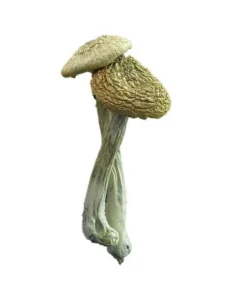
MAGIC MUSHROOMS
Psilocybe Azurescens – Ultra-Potent Wild Psilocybin Mushroom
Price range: $180.00 through $870.00
This product has multiple variants. The options may be chosen on the product page 
MAGIC MUSHROOMS
Price range: $178.00 through $840.00
This product has multiple variants. The options may be chosen on the product page 
MAGIC MUSHROOMS
Price range: $190.00 through $890.00
This product has multiple variants. The options may be chosen on the product page 
Price range: $190.00 through $890.00
This product has multiple variants. The options may be chosen on the product page 
Price range: $190.00 through $890.00
This product has multiple variants. The options may be chosen on the product page 
Price range: $180.00 through $910.00
This product has multiple variants. The options may be chosen on the product page 
MAGIC MUSHROOMS
Price range: $180.00 through $860.00
This product has multiple variants. The options may be chosen on the product page 
Price range: $170.00 through $830.00
This product has multiple variants. The options may be chosen on the product page
Aubrielle Haney (verified owner) –
I felt supported, even though I was alone.
Alfred Marsh (verified owner) –
I can’t remember the last time I felt this seen, calm, and grounded. It started with a respectful order process.
Holly Ferrell (verified owner) –
It brought me peace.
Aitana Granger (verified owner) –
Profoundly grateful for this medicine.
Jeremias Gold (verified owner) –
A soul massage.
Giselle Durham (verified owner) –
The clarity stayed with me long after.
Taryn Huffman (verified owner) –
I trust the process, because I trust this supplier.
Opal Stanford (verified owner) –
It felt like the mushrooms knew what I needed.
Bo St. Clair (verified owner) –
An emotional and spiritual upgrade.
Ares Sutter (verified owner) –
The best experience I’ve had in years.
Matthias Reaves (verified owner) –
The best experience I’ve had in years.
Samuel Simmons (verified owner) –
The emotional relief I felt was immediate and lasting. The product arrived exactly when it needed to.
Elena Blake (verified owner) –
These are people you can trust with a powerful tool. That matters more than anything.
Ashley Miller (verified owner) –
There’s something powerful about feeling supported even before the journey begins. This site really delivers that.
Darian Radford (verified owner) –
A guided, intuitive healing experience.
Maurice Lowe (verified owner) –
From the first click to the last reflection after my session, I felt supported. Customer service responded fast and with care.
Gerald Tate (verified owner) –
I felt supported before I even began. That made the emotional openness during the session much easier.
Wesley Brady (verified owner) –
This helped unlock something in me, and the trust I felt toward the provider only deepened the experience.
Makayla Myers (verified owner) –
Ordering was simple and smooth, and the support I felt during and after my session was something I didn’t expect from a website.
Phillip Swanson (verified owner) –
The professionalism here is unmatched — respectful tone, fast replies, and packaging that made me feel at ease.
Leonard Cobb (verified owner) –
The moment I opened the package, I could tell this team values the experience as much as the product.
Casey Hoffman (verified owner) –
It didn’t feel like a purchase — it felt like someone handing me a key to a locked door inside myself.
Elijah Morris (verified owner) –
The packaging was neat and well organized.
Emery Horton (verified owner) –
It felt like my thoughts were being held by something kind and wise.
Willow Love (verified owner) –
Beautiful experience, smooth journey, and zero stress about shipping. These folks know exactly what they’re doing.
Kaitlyn Reed (verified owner) –
It’s incredible how something this subtle and powerful was also delivered so discreetly.
Michael Williams (verified owner) –
No distractions, no confusion — just a clean, easy journey into myself.
Bryan Patterson (verified owner) –
The experience wasn’t just visual — it was deeply emotional and grounding.
Bobby Owens (verified owner) –
The purchasing process couldn’t have been easier.
Vivian Perry (verified owner) –
Really happy with the level of service.
Jasmine Ramirez (verified owner) –
This helped me rewrite some inner scripts I didn’t know I was still carrying. The professionalism made me feel safe enough to go there.
Luke Bennett (verified owner) –
Every step felt respectful, like this wasn’t just about selling something — it was about helping someone reconnect with themselves.
Louis Doyle (verified owner) –
Incredible introspective depth. I could finally hear my intuition clearly.
Randy Wolfe (verified owner) –
This journey opened my eyes and softened my heart. I’m so grateful for the professionalism that made it possible.
Lauren Alexander (verified owner) –
Very happy with the attention to detail.
Vivian Perry (verified owner) –
A very pleasant purchasing experience.
Danielle Cole (verified owner) –
Everything was simple and convenient.
Corey McDonald (verified owner) –
Everything arrived neatly packaged.
Eva Brooks (verified owner) –
A great experience with no unnecessary complications.
Donald Patterson (verified owner) –
Everything was handled smoothly.
Lucy Parker (verified owner) –
The packaging was secure and presentable.
Nicholas King (verified owner) –
Everything was delivered in good condition.
Emilia Rogers (verified owner) –
Very satisfied with the overall experience.
Ashley Foster (verified owner) –
Everything was clearly explained.
Aria King (verified owner) –
Everything worked out perfectly.
Kennedy Reed (verified owner) –
Really appreciated the clear communication.
Corey McDonald (verified owner) –
Everything was carefully organized.
Sadie Watson (verified owner) –
The whole experience was excellent.
Eric Allen (verified owner) –
Very satisfied with the overall experience.
Donald Patterson (verified owner) –
Very happy with the overall outcome.
Ella Thompson (verified owner) –
Everything was packaged neatly and arrived in good condition.