
No products in the cart.
Psilocybe cyanofibrillosa – Rare Forest Mushroom by Guzmán & Stamets
Price range: $190.00 through $890.00
Psilocybe cyanofibrillosa is a rare, forest-dwelling psilocybin species known for its spiritual depth and balanced psychoactive profile. A collector’s favorite.
Psilocybe cyanofibrillosa: Essential Identification and Habitat Guide
Psilocybe cyanofibrillosa is a name used for a small, blue-staining, wood-associated Psilocybe historically reported from the Pacific Northwest. Descriptions emphasize a hygrophanous brown cap, fibrillose pale stem, dark purple-brown spores, and woody habitat. Current taxonomic sources and microscopy or molecular evidence should be consulted because morphology alone cannot reliably establish species identity.
Overview
Psilocybe cyanofibrillosa is a taxonomic name associated with a small, wood-inhabiting, blue-staining Psilocybe historically reported from western North America, particularly the Pacific Northwest. The name appears in mycological literature in connection with collections from Oregon, Washington, British Columbia, and northern California, where cool, moist coastal conditions support a diverse assemblage of wood-decaying fungi.
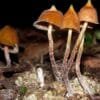
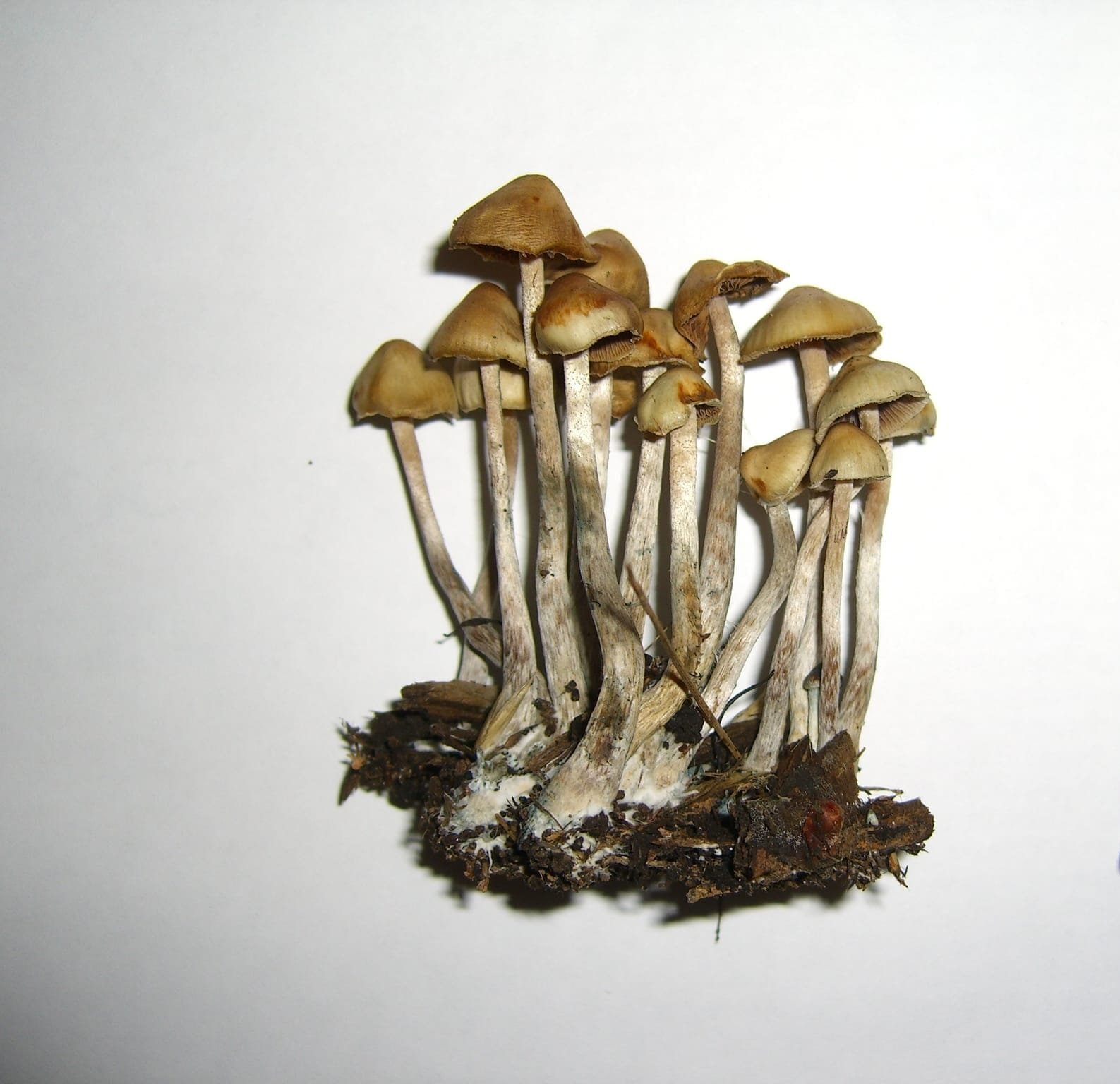
Historical descriptions characterize the species by a hygrophanous brown pileus, a fibrillose pale stipe, dark purple-brown spores, and growth on decomposing woody material. The fibrillose stipe surface is frequently cited as a distinguishing feature relative to closely related species such as Psilocybe cyanescens, whose mature specimens tend to develop a conspicuously wavy cap margin. Both produce the blue discoloration associated with psilocin-related chemistry in damaged tissue.
Identification is complicated by overlapping morphology among small brown wood-associated fungi in the Pacific Northwest, including the potentially lethal Galerina marginata. No combination of field characteristics provides the certainty that microscopic examination or molecular analysis can offer when morphology, ecology, voucher provenance, and molecular evidence are evaluated together. Psilocybin and psilocin, the primary alkaloids associated with this species, are Schedule I controlled substances under U.S. federal law.
This article is provided for scientific, educational, and harm-reduction purposes. Sources were reviewed through July 2025.
Evidence Quality and Research Limitations
Scientific claims about Psilocybe cyanofibrillosa rest on a more limited published record than better-studied species such as P. cyanescens. Understanding the quality of available evidence is essential context for interpreting everything that follows.
Herbarium-vouched specimens represent physically preserved, documented records with locality and collector data. These form the authoritative basis for morphological descriptions and distributional claims. The relatively small number of vouched collections for P. cyanofibrillosa means that many circulating descriptions derive from a limited original specimen base.
Sequence-confirmed records link morphological observations to molecular data deposited in curated databases. Publicly accessible sequence-confirmed records for this specific taxon appear limited in major databases, which affects the reliability of molecular identification using P. cyanofibrillosa as a reference.
Peer-reviewed chemical analyses using validated methods such as HPLC and LC-MS provide the most defensible basis for alkaloid content claims. Published quantitative chemical data specific to authenticated P. cyanofibrillosa specimens are not prominent in the peer-reviewed literature, meaning potency claims should be treated as provisional.
Curated biodiversity observations from databases such as GBIF aggregate records of varying verification quality. Many lack microscopy, spore print data, or molecular confirmation and should not be treated as equivalent to vouched records.
Field reports and citizen-science observations contribute distributional information of variable reliability and should be read as hypothesis-generating rather than confirmatory evidence.
This article distinguishes these categories throughout. Readers using this content for research or educational purposes should consult primary sources and current taxonomic treatments directly.
Psilocybe cyanofibrillosa Taxonomy and Nomenclature
Psilocybe cyanofibrillosa is attributed to Rolf Singer and Alexander H. Smith, published in 1958 in the monograph Mycologia supplement series addressing North American Psilocybe taxa. Singer, whose broad systematic work on the Agaricales shaped much of twentieth-century classification, and Smith, known extensively for his contributions to North American fungal taxonomy, described numerous Psilocybe taxa during a period when species boundaries were established primarily through morphological examination.
The species belongs to the following taxonomic hierarchy:
- Kingdom: Fungi
- Phylum: Basidiomycota
- Class: Agaricomycetes
- Order: Agaricales
- Family: Hymenogastraceae
- Genus: Psilocybe
- Species: Psilocybe cyanofibrillosa Singer and A.H. Sm.
Current Taxonomic Status
The valid nomenclatural status of this name should be verified against current authoritative resources before any research or educational use. MycoBank and Index Fungorum are the primary international registries for fungal nomenclature and are the appropriate starting points for confirming whether a name is currently accepted, synonymized, or otherwise modified by subsequent taxonomic work.
Molecular phylogenetic studies have substantially revised the boundaries of Psilocybe and the family Hymenogastraceae since the original morphological descriptions were published. Research by Matheny and colleagues demonstrated that psilocybin-producing Psilocybe species form a distinct clade within Hymenogastraceae, separate from morphologically similar but phylogenetically distant taxa. Species recognized in older morphological literature may require reinterpretation when evaluated against sequence-based evidence, and it is possible that P. cyanofibrillosa as historically circumscribed does not correspond to a genetically distinct lineage separable from closely related taxa by available molecular markers.
Readers citing this taxon in research should confirm current accepted status, documented synonyms, and type specimen information directly from MycoBank or Index Fungorum rather than relying on secondary sources.
Psilocybe cyanofibrillosa Identification: Physical and Microscopic Features
Direct answer: Psilocybe cyanofibrillosa identification relies on a combination of morphology, microscopy, ecology, and, where available, molecular evidence. Historical descriptions emphasize a hygrophanous brown cap, pale fibrillose stipe, blue discoloration after injury, and dark purple-brown spores. No single visible feature establishes species identity or mushroom safety.
Identification at a Glance
The following table summarizes historically described characteristics alongside key features of the most safety-critical lookalike. Field conditions, specimen age, and individual variation affect all of these features. This table is an orientation tool rather than an identification key.
| Feature | Psilocybe cyanofibrillosa | Galerina marginata |
|---|---|---|
| Cap color | Hygrophanous brown to buff | Hygrophanous tawny to ochre |
| Cap margin | Even to slightly irregular | Even, occasionally wavy |
| Stipe surface | Fibrillose, silky | Smooth to fibrillose |
| Spore print | Dark purple-brown | Rusty-brown to ochre |
| Bluing reaction | Typically present | Absent |
| Veil remnants | Faint fibrillose zone | Persistent membranous ring |
| Substrate | Woody debris, woodchips | Wood, stumps, woody debris |
| Primary toxin concern | Psilocybin-class alkaloids | Amatoxins potentially present |
| Microscopy required | Yes | Yes |
Cap (Pileus)
Historical descriptions characterize the cap as small, with morphological dimensions recorded in the original taxonomic literature; the specific measurements cited by Singer and Smith in their 1958 treatment should be consulted directly for authoritative figures. The surface is hygrophanous, shifting from chestnut or cinnamon-brown when fully hydrated to pale buff or straw as moisture is lost. This color gradient, typically darker at the disc and paler toward the margin, is a broadly shared trait among hygrophanous Psilocybe species and is not diagnostic on its own.
The margin is described as even to slightly irregular in younger and intermediate specimens, without the conspicuously wavy or undulate margin that characterizes mature Psilocybe cyanescens. This distinction is useful contextually but may be subtle in practice and is affected by hydration, age, and handling.
Gills (Lamellae)
The lamellae are adnate to adnexed, moderately crowded, and progress from pale coloration in young specimens through grayish-brown to dark purple-brown as spores mature. Gill edges are typically paler than the faces. Darkening with age reflects spore maturation and is informative when evaluated alongside spore print color and other features.
Stem (Stipe)
The fibrillose stipe is among the most frequently cited distinguishing features in historical descriptions. The surface is covered with fine threadlike fibers or fibrils, producing a silky or hairy texture, and coloration is whitish to pale buff. The base often shows white mycelial fibers or rhizomorphic strands connecting the fruiting body to the substrate. A faint partial veil may leave traces on younger specimens, but a well-developed persistent ring is absent, in contrast to Galerina marginata.
The term fibrillose refers to this surface texture and is a morphological descriptor rather than a species-specific identifier. Stipe tissue typically shows blue discoloration when damaged.
Spore Print
A dark purple-brown to violet-brown spore print is one of the more useful macroscopic distinctions from Galerina marginata, which produces a rusty-brown to ochre deposit. Spore print collection requires placing a fresh cap gill-side down on paper for several hours in a draft-free environment. Perceived color can vary under different lighting conditions, and any ambiguity should prompt additional investigation rather than a safety conclusion.
Bluing Reaction
Damaged tissue in psilocybin-containing Psilocybe species typically develops blue discoloration through an enzymatic cascade. Research published in Angewandte Chemie by Lenz and colleagues in 2020 identified this as a damage-triggered process in which phosphatase activity releases psilocin from psilocybin, which is then oxidized through a copper-dependent laccase reaction to form blue oligomeric pigments. Bluing is a useful indicator but occurs in other fungi and cannot confirm species identity. Its absence does not exclude a psilocybin-containing species, as reaction intensity varies with specimen condition and age.
Psilocybe cyanofibrillosa Microscopy
Direct answer: Psilocybe cyanofibrillosa microscopy examines spore dimensions and shape, germ-pore morphology, basidia, cheilocystidia, pleurocystidia, and pileipellis architecture. Measurements should be compared with the original taxonomic description or authenticated reference material because microscopic dimensions can overlap among closely related Psilocybe species.
Key features to evaluate include spore morphology, dimensions, wall thickness, and germ pore characteristics; cheilocystidia and pleurocystidia morphology; pileipellis structure; and basidia configuration. Specific dimensions from the original Singer and Smith description should be consulted for authoritative reference values and compared against current treatments where available. Regional mycological societies and university natural history programs sometimes provide access to microscopy resources and expertise.
Psilocybe cyanofibrillosa Habitat, Substrate, and Ecology
Direct answer: Historical records associate Psilocybe cyanofibrillosa habitat with cool, moist, woody environments of western North America, particularly the Pacific Northwest. Reported substrates include decomposing hardwood debris, woodchips, and riparian organic material. Distribution claims are strongest when supported by authenticated herbarium vouchers rather than observation-only records.
Substrate and Microhabitat
Historical accounts describe P. cyanofibrillosa as lignicolous, growing on or directly associated with decomposing woody material. Substrates include woody debris, woodchips, and the bases of decaying hardwood stumps. Red alder (Alnus rubra) is among the hardwood species cited in association with Pacific Northwest collections. The species has been described from riparian areas, stream banks, and other moist, shaded environments where organic debris accumulates.
Unlike Psilocybe cyanescens, which has become prominently associated with landscaped woodchip beds and urban-disturbed habitats, historical descriptions of P. cyanofibrillosa more consistently emphasize natural woodland settings. This ecological distinction, while informative, depends on verified documented collections rather than generalized habitat descriptions.
Psilocybe cyanofibrillosa Distribution: Verified vs. Reported Records
Direct answer: Distribution claims for Psilocybe cyanofibrillosa center on the Pacific Northwest of North America, with historical collections from Oregon, Washington, British Columbia, and northern California. The strength of any distributional claim depends directly on the verification standard applied to the underlying records.
Available records for this taxon fall into meaningfully different categories of reliability. Herbarium-vouched specimens with associated locality data represent the most authoritative evidence for confirmed occurrence at a given location. Sequence-confirmed records, in which a morphological collection is linked to molecular data deposited in a curated database, provide additional taxonomic confidence. Curated biodiversity observations submitted to platforms such as the Global Biodiversity Information Facility represent a third tier; many lack microscopy, spore print data, or molecular confirmation and should not be equated with vouched material.
Any Psilocybe cyanofibrillosa distribution map built primarily from observation-only records reflects identification uncertainty rather than confirmed range. Researchers assessing distribution should weight record categories accordingly and consult herbarium collections at institutions such as the University of Washington or Oregon State University where Pacific Northwest fungal collections are held.
Psilocybe cyanofibrillosa Season and Fruiting Conditions
Fruiting in Pacific Northwest Psilocybe species is generally associated with cool, wet conditions characteristic of autumn and early winter in the region’s maritime climate. Temperature drops, increased precipitation, and substrate moisture collectively influence fruiting initiation and duration at a given site. Historical collections and field observations suggest a similar autumn fruiting pattern for P. cyanofibrillosa, though the documented record is more limited compared to better-collected species such as P. cyanescens.
Microclimate, canopy cover, substrate depth, and site-level moisture retention all affect local fruiting windows, which can vary considerably among sites and across years.
Psilocybe cyanofibrillosa Potency and Alkaloid Content
Direct answer: Psilocybe cyanofibrillosa potency is not represented by a scientifically established universal percentage. Species-specific quantitative chemical evidence appears limited in the peer-reviewed literature, and measurements vary with specimen identity, developmental stage, storage, degradation, and analytical method. Precise potency claims require authenticated specimens analyzed by validated methods such as HPLC or LC-MS.
Primary Alkaloids
The principal psychoactive compounds associated with blue-staining Psilocybe species are psilocybin (4-phosphoryloxy-N,N-dimethyltryptamine) and psilocin (4-hydroxy-N,N-dimethyltryptamine). Following ingestion, enzymatic dephosphorylation converts psilocybin to psilocin, which acts as a partial agonist at serotonin receptors, particularly the 5-HT2A receptor, producing its primary pharmacological effects. Baeocystin and norbaeocystin have been documented in related Psilocybe species and may be present in P. cyanofibrillosa, though specific quantitative data for this taxon are limited in the peer-reviewed literature.
Analytical Variability
Alkaloid concentrations in psilocybin-containing mushrooms vary with developmental stage, environmental conditions, substrate, storage duration, drying method, and the analytical techniques used. High-performance liquid chromatography and liquid chromatography-mass spectrometry are standard methods for quantitative analysis. Comparisons between species or populations are meaningful only when specimens are taxonomically authenticated, methodologically equivalent, and analyzed under comparable conditions. Published analytical work by Bigwood and Beug demonstrated substantial within-species and between-flush variability in psilocybin concentrations even under controlled collection conditions, illustrating why single-specimen measurements should not be generalized to species-level potency claims.
Psilocybe cyanofibrillosa Lookalikes and Identification Risks
Direct answer: Several small brown wood-associated fungi in the Pacific Northwest share morphological features with Psilocybe cyanofibrillosa. Galerina marginata is the most dangerous because it grows on identical substrates and can contain potentially lethal amatoxins. No spore color, bruising response, stipe texture, or photograph alone establishes mushroom safety. Microscopy, spore print examination, and ideally molecular analysis should inform any identification claim.
Galerina marginata
Galerina marginata is the most safety-critical lookalike for any small brown wood-associated Psilocybe species in temperate North America. It can contain potentially lethal concentrations of amatoxins, including alpha-amanitin, which causes delayed-onset hepatotoxicity and can be fatal without prompt medical intervention. The North American Mycological Association identifies Galerina marginata as one of the most dangerous mushrooms encountered in North America, and fatal poisonings from this species are documented in the medical literature.
Galerina marginata typically produces a rusty-brown to ochre spore print, contrasting with the dark purple-brown print of psilocybin-containing Psilocybe species. A persistent, well-developed membranous ring is characteristic of younger Galerina specimens, whereas P. cyanofibrillosa typically shows only faint fibrillose veil traces. Galerina does not exhibit the bluing reaction associated with psilocin-related chemistry. Despite these differences, field features can overlap, vary with age and condition, and prove difficult to evaluate reliably in the field. Co-occurrence of Galerina and Psilocybe species on shared substrates has been observed, meaning mixed collections are possible.
No single field characteristic, including spore print color, bluing reaction, or stipe texture, is sufficient to confirm P. cyanofibrillosa identity or to exclude Galerina marginata at a level of certainty adequate for safety. Suspected mushroom poisoning requires immediate contact with Poison Control (U.S.: 1-800-222-1222) and emergency medical evaluation.
Psilocybe cyanofibrillosa vs Psilocybe cyanescens
Direct answer: Historical descriptions separate Psilocybe cyanofibrillosa from P. cyanescens primarily through morphology. P. cyanofibrillosa is described with a more even cap margin and a conspicuously fibrillose stipe, whereas mature P. cyanescens typically develops a strongly wavy or undulate cap margin. Modern molecular evidence should be consulted before treating historical morphological boundaries as definitive.
| Feature | P. cyanofibrillosa | P. cyanescens |
|---|---|---|
| Cap margin | Even to slightly irregular | Conspicuously wavy when mature |
| Stipe surface | Prominently fibrillose | Smooth to silky fibrillose |
| Habitat emphasis | Natural woodland, riparian | Woodchip beds, disturbed habitats |
| Geographic range | Pacific Northwest | Pacific Northwest and Europe |
| Spore print | Dark purple-brown | Dark purple-brown |
| Bluing reaction | Present | Present |
| Molecular confirmation | Advisable | Advisable |
These distinctions are drawn from historical morphological descriptions. Current molecular and taxonomic literature should be consulted to determine how reliably these criteria separate genetically distinct taxa.
Psilocybe cyanofibrillosa vs Psilocybe pelliculosa
Psilocybe pelliculosa is another small, brown, Pacific Northwest Psilocybe associated with woody and forest-floor substrates. It is generally described as having a separable gelatinous pellicle on the cap surface, a feature that can help distinguish it from P. cyanofibrillosa when fresh and in good condition. Both are small hygrophanous species with dark spores occurring in overlapping geographic ranges. Microscopy and ideally molecular analysis are the most reliable means of distinguishing between closely related Psilocybe species in this complex.
Psilocybe stuntzii, Inocybe, and Pholiotina
Additional morphologically similar taxa include Psilocybe stuntzii, a blue-staining species associated with grass and woody debris in the Pacific Northwest, and members of Inocybe and Pholiotina, some of which contain amatoxins or other toxic compounds. These genera share the general appearance of small brown mushrooms but differ in spore color, microscopic anatomy, ecology, and chemistry. Confusion with these genera reinforces the need for comprehensive identification extending beyond macroscopic observation.
Psilocybe cyanofibrillosa Microscopy and DNA Identification
Why Microscopy Matters
Light microscopy allows evaluation of features invisible to the naked eye that carry substantially greater taxonomic weight than most macroscopic observations. Relevant microscopic features include spore shape, dimensions, wall thickness, and germ pore characteristics; cheilocystidia and pleurocystidia morphology; pileipellis architecture; and basidia number and configuration. These structures differ among closely related species in ways macroscopic examination cannot resolve, and comparison against the original Singer and Smith description or authenticated reference material is necessary for any identification claim approaching research-grade confidence.
DNA Barcoding and Sequence-Based Identification
Molecular identification using the internal transcribed spacer region of ribosomal DNA, compared against verified sequences in databases such as GenBank, can provide strong species-level resolution for morphologically cryptic fungi. However, identification confidence from molecular methods depends on reference database completeness, marker resolution, specimen quality, and whether closely related taxa are adequately represented with authenticated sequences.
For a species with a limited published molecular record such as P. cyanofibrillosa, reference sequences for comparison may be sparse or absent, which reduces the reliability of sequence-based identification for this specific taxon. Identification confidence is strongest when macroscopic morphology, microscopy, ecology, voucher provenance, and appropriately interpreted molecular evidence converge rather than when any single method is applied in isolation. Voucher deposits of physically preserved material linked to sequence data in GenBank contribute to the reference database and support future taxonomic work. Index Fungorum and MycoBank provide nomenclatural context alongside sequence data.
Psilocybe cyanofibrillosa Lifecycle
Like other basidiomycete fungi, Psilocybe cyanofibrillosa progresses through a characteristic developmental sequence. Basidiospores released from mature fruiting bodies are dispersed by wind or water movement. Under suitable moisture and temperature conditions, a germinating spore produces primary hyphae. When hyphae of compatible mating types encounter one another and fuse, the resulting dikaryotic mycelium carries two distinct nuclear identities in each hyphal compartment.
The dikaryotic mycelium colonizes and decomposes woody substrate, extracting nutrients through enzymatic breakdown of lignin and cellulose. Rhizomorphic mycelial strands, visible as white fibers at the base of fruiting bodies, facilitate substrate colonization and are noted in descriptions of this and related Pacific Northwest species. The mycelium can persist in suitable substrate across seasons.
When environmental conditions are favorable, typically the cooling temperatures and increased precipitation of Pacific Northwest autumn, the mycelium initiates primordia that develop into fruiting bodies. Mature basidia on the gill surfaces bear typically four basidiospores each, which are discharged and dispersed to initiate the next cycle. The macroscopic mushroom represents only the reproductive structure of the organism; the mycelium constitutes the persistent, ecologically active body of the fungus.
Psilocybe cyanofibrillosa Legal Status in the USA
Direct answer: Psilocybin and psilocin remain Schedule I controlled substances under U.S. federal law. State and local reforms do not eliminate federal restrictions. Laws affecting fungal spores and related biological material vary by jurisdiction and activity, so researchers should verify current statutes rather than relying on vendor policies or generalized online legality summaries.
United States Federal Law
Psilocybin and psilocin are classified as Schedule I controlled substances under the Controlled Substances Act. This classification applies to the compounds themselves and extends to mushrooms and other biological material containing them. Possession, manufacture, distribution, and related activities are subject to federal criminal penalties regardless of state or local policy.
Questions about the legal status of fungal spores, which do not themselves contain psilocybin or psilocin, are not governed by a single uniform rule and vary by jurisdiction and intended use. Researchers should verify applicable federal and state law before acquiring, possessing, or transferring any biological material associated with controlled-substance-containing organisms.
State-Level Developments
Several U.S. jurisdictions have modified the legal landscape for psilocybin at the state or local level, though none of these changes alter federal law or provide protection from federal enforcement.
Oregon Psilocybin Services, established through Measure 109 passed in 2020, created a regulated framework for supervised psilocybin administration at licensed facilities. Colorado Proposition 122, implemented through the Natural Medicine Health Act, established regulated access frameworks for psilocybin and related compounds in that state. Additional municipalities have adopted enforcement-deprioritization or decriminalization policies that vary in scope and legal effect.
Individuals and researchers should consult current legal guidance specific to their jurisdiction before drawing conclusions about lawful activity.
Safety Considerations
Accurate identification of Psilocybe cyanofibrillosa is a genuine safety matter. Galerina marginata, which can contain lethal concentrations of alpha-amanitin and related amatoxins, grows in identical substrate conditions and can closely resemble psilocybin-containing Psilocybe species in the field. Amatoxin poisoning characteristically presents with delayed onset, often 6 to 24 hours or more after ingestion, which can create a false sense of safety before severe hepatotoxic effects develop. Fatal poisonings from Galerina are documented in the medical literature.
Reliable identification requires convergent evidence from macroscopic features, microscopy, ecological context, and, for research-grade conclusions, molecular confirmation. Identification from photographs is not adequate for safety purposes under any circumstances. Blue staining alone does not confirm species identity. A dark spore print alone does not exclude dangerous species.
Any suspected mushroom poisoning, or any unexpected or neurological symptom following mushroom ingestion, warrants immediate contact with Poison Control (U.S.: 1-800-222-1222) and emergency medical evaluation. Do not wait for symptoms to worsen before seeking help.
Psilocybe cyanofibrillosa: Key Identification and Research Takeaways
Psilocybe cyanofibrillosa is a taxonomic name attributed to Singer and Smith, associated with a small, blue-staining, wood-inhabiting Psilocybe historically reported from the Pacific Northwest of North America. Its distinguishing characteristics in historical descriptions include a hygrophanous brown cap with an even to slightly irregular margin, a prominently fibrillose pale stipe, dark purple-brown spores, and growth on decomposing woody material in cool moist environments.
Confident identification draws on macroscopic morphology, spore print examination, microscopy of spores and cystidia, ecological context, and molecular sequence evidence where available. The limited published molecular record for this taxon means that historical species boundaries should be interpreted cautiously and evaluated against current taxonomic and nomenclatural sources such as MycoBank and Index Fungorum. Distribution claims are most defensible when supported by herbarium-vouched material rather than observation-only records.
Galerina marginata presents the most serious safety risk among morphologically similar species and requires that every identification decision involving small brown wood-associated mushrooms be supported by multiple convergent lines of evidence. Psilocybin and psilocin remain Schedule I controlled substances under U.S. federal law, and state-level legal frameworks vary substantially in scope and do not eliminate federal restrictions.
For research, educational, or harm-reduction purposes, the most defensible conclusions rest on herbarium-vouched specimens, peer-reviewed chemical analyses, sequence-confirmed records, and authoritative taxonomic and toxicological sources rather than on field observation or informal reporting alone.
Frequently Asked Questions
What is Psilocybe cyanofibrillosa?
Psilocybe cyanofibrillosa is a taxonomic name associated with a small, blue-staining, wood-inhabiting Psilocybe historically reported from western North America. Historical descriptions emphasize a hygrophanous cap, fibrillose stipe, purple-brown spores, and woody substrates. Current nomenclatural status should be verified against MycoBank or Index Fungorum.
How do you identify Psilocybe cyanofibrillosa?
Identification uses multiple characteristics including cap and stipe morphology, blue discoloration after injury, spore deposit color, microscopic anatomy, substrate, geographic context, and potentially DNA sequence evidence. No single field characteristic establishes species identity or safety.
Where does Psilocybe cyanofibrillosa grow?
Historical accounts associate P. cyanofibrillosa with cool, moist, woody environments in western North America, particularly Oregon, Washington, British Columbia, and northern California. Distribution claims are strongest when supported by authenticated herbarium specimens and current taxonomic evidence rather than observation-only records.
What does fibrillose mean in mushroom identification?
Fibrillose describes a surface covered with fine, threadlike fibers or fibrils. A fibrillose stipe has a finely fibrous or silky texture. It is a morphological descriptor rather than a species-specific identification feature.
What is the difference between Psilocybe cyanofibrillosa and Psilocybe cyanescens?
Historical descriptions distinguish P. cyanofibrillosa by its prominently fibrillose stipe and more even cap margin, while mature P. cyanescens commonly develops a conspicuously wavy or undulate cap margin. Current molecular evidence should be consulted before treating these morphological boundaries as definitive.
How does Psilocybe cyanofibrillosa differ from Galerina marginata?
Galerina marginata typically produces rusty-brown rather than dark purple-brown spores and has a persistent membranous ring absent in P. cyanofibrillosa. Galerina can contain potentially lethal amatoxins. No single field feature is sufficient to establish that a wild mushroom is safe to consume.
How potent is Psilocybe cyanofibrillosa?
A reliable universal potency figure has not been established in the peer-reviewed literature. Quantitative alkaloid claims should be based on chemically analyzed, taxonomically authenticated specimens, because measurements vary with specimen condition, developmental stage, storage, and analytical methodology.
Are Psilocybe cyanofibrillosa spores legal in the United States?
There is no single uniform rule. Psilocybin and psilocin are federally controlled substances, while laws concerning spores and fungal material vary by jurisdiction and intended use. Researchers should verify current federal and state law before acquiring, possessing, or transferring relevant biological material.
References and Primary Sources
Nomenclature and taxonomy
MycoBank — fungal nomenclature registry
Index Fungorum — fungal names database
Molecular phylogenetics and family placement
Matheny, P.B., et al. (2006). Major clades of Agaricales: a multilocus phylogenetic overview. Mycologia 98(6): 982–995. doi:10.3852/mycologia.98.6.982
Bluing reaction chemistry
Lenz, C., et al. (2020). Injury-triggered blueing reactions of Psilocybe “magic” mushrooms. Angewandte Chemie International Edition 59(4): 1450–1454. doi:10.1002/anie.201910175
Alkaloid variability
Bigwood, J., and Beug, M.W. (1982). Variation of psilocybin and psilocin levels with repeated flushes and age of fruiting bodies of Psilocybe cubensis. Journal of Ethnopharmacology 5(3): 287–291. doi:10.1016/0378-8741(82)90014-9
5-HT2A receptor pharmacology
National Center for Biotechnology Information — Serotonin receptors
Galerina marginata and amatoxin toxicology
North American Mycological Association — Galerina marginata
Poison Control — Mushroom poisoning
Occurrence records
Global Biodiversity Information Facility
DNA barcoding and sequence databases
NCBI GenBank
International Barcode of Life
DEA scheduling
Drug Enforcement Administration — Drug scheduling
Oregon Psilocybin Services
Oregon Health Authority — Oregon Psilocybin Services
Colorado Natural Medicine Health Act
Colorado Department of Public Health and Environment — Natural Medicine
| QUANTITY | OZ, 1/4 POUND, 1/2 POUND, POUND |
|---|
51 reviews for Psilocybe cyanofibrillosa – Rare Forest Mushroom by Guzmán & Stamets
Add a review
Related products
Price range: $180.00 through $910.00
This product has multiple variants. The options may be chosen on the product page 
MAGIC MUSHROOMS
Price range: $178.00 through $840.00
This product has multiple variants. The options may be chosen on the product page 
Price range: $180.00 through $910.00
This product has multiple variants. The options may be chosen on the product page 
Price range: $185.00 through $920.00
This product has multiple variants. The options may be chosen on the product page 
Price range: $180.00 through $890.00
This product has multiple variants. The options may be chosen on the product page 
Price range: $185.00 through $860.00
This product has multiple variants. The options may be chosen on the product page 
MAGIC MUSHROOMS
Price range: $180.00 through $860.00
This product has multiple variants. The options may be chosen on the product page 
Price range: $190.00 through $890.00
This product has multiple variants. The options may be chosen on the product page
Amaya Rosenthal (verified owner) –
It felt like the mushrooms knew what I needed.
Royce Cardenas (verified owner) –
From order to experience, everything was seamless and comforting.
Elisa Penn (verified owner) –
The trip felt like an emotional detox.
Celeste Lott (verified owner) –
Very trustworthy team.
Dylan Flores (verified owner) –
I was amazed at how fast it arrived, and the experience itself was like pressing the reset button on my inner life.
Aria McCray (verified owner) –
Exactly what I was hoping for—clarity, peace, insight.
Nathan Phillips (verified owner) –
Fast, stealthy delivery and amazing quality. I could feel the professionalism behind every step.
Saige Goddard (verified owner) –
My mind feels like it went through a spring cleaning.
Bryce Harper (verified owner) –
From shipping to set and setting, the whole thing was flawless. I felt truly taken care of.
Zaylee Radcliffe (verified owner) –
Felt deeply connected to the earth.
Gerald Tate (verified owner) –
The professionalism here is unmatched — respectful tone, fast replies, and packaging that made me feel at ease.
Brandon Hall (verified owner) –
I felt held the entire time — from opening the package to the final moments of deep reflection.
Olivia Carter (verified owner) –
There’s something beautiful about knowing you’re in safe hands — this experience gave me deep peace, and the process made me feel completely supported.
Bria Gallegos (verified owner) –
A truly introspective and cosmic experience. I’m still integrating the lessons.
Terry Bowers (verified owner) –
I was able to open up to myself in ways I’d never done before. Trusting the provider made all the difference.
Hunter Butler (verified owner) –
I finally found a supplier that doesn’t just deliver on quality but treats the whole process with deep respect.
Tessa Carver (verified owner) –
Deep inner clarity, and a new perspective.
Noelle Savage (verified owner) –
It felt like my nervous system finally relaxed, and I could breathe again.
Ellianna Langley (verified owner) –
Great for a solo spiritual reset. The quality gave me confidence.
Lena McFadden (verified owner) –
It felt like the mushrooms knew what I needed.
Bruce Moss (verified owner) –
Soft, subtle, yet deeply moving. It gave me permission to feel.
Leah Bryant (verified owner) –
Every thought felt intentional. Like my mind was guiding me through healing.
Russell Vaughn (verified owner) –
Beautiful, delicate, and full of hidden lessons. I’m still unpacking it days later.
Patrick Sanders (verified owner) –
I was able to open up to myself in ways I’d never done before. Trusting the provider made all the difference.
Olivia Carter (verified owner) –
The emotional clarity I got from this experience has stayed with me.
Valerie Barrett (verified owner) –
I’ve never had such a deeply emotional experience from something so simple. The quality here is unmatched.
Dennis Walsh (verified owner) –
Every little detail, from delivery to dosage info, was done with purpose. That made a huge difference for me.
Keira Blake (verified owner) –
From the first click to the last reflection after my session, I felt supported. Customer service responded fast and with care.
Jacob Roberts (verified owner) –
The emotional relief I felt was immediate and lasting. The product arrived exactly when it needed to.
Nina Elliott (verified owner) –
A life-changing journey made possible by the calm, professional experience from start to finish.
Eliana Coleman (verified owner) –
The purchasing experience was excellent.
Kyle Howard (verified owner) –
This helped me feel connected to the world again in a way I didn’t know I needed. It was like waking up from a long emotional fog.
Kinsley Murphy (verified owner) –
The process was organized and efficient.
Brandon Harris (verified owner) –
Really pleased with how everything turned out.
Audrey Turner (verified owner) –
Everything matched my expectations.
Hannah Adams (verified owner) –
Everything was carefully organized.
Autumn Sanders (verified owner) –
Great experience with no complications.
Ronald Hughes (verified owner) –
Really satisfied with the communication.
Mia Anderson (verified owner) –
Everything was carefully organized.
Adam Green (verified owner) –
Smooth ordering process and everything went as expected.
Adam Green (verified owner) –
The whole process exceeded my expectations.
Layla Nelson (verified owner) –
Very satisfied with the entire process.
Jeffrey Sanders (verified owner) –
Everything was handled professionally from start to finish.
Nicole Ford (verified owner) –
Excellent experience overall. Everything was straightforward.
Amanda Sullivan (verified owner) –
Everything went smoothly. Five stars.
Sydney Diaz (verified owner) –
The process was organized and efficient.
Steven Young (verified owner) –
Everything was organized and easy to follow.
Brandon Harris (verified owner) –
Very happy with how my order was handled.
Alice Howard (verified owner) –
Very pleased with how efficiently everything went.
Victoria Allen (verified owner) –
Everything went smoothly. Five stars.
Roger Hayes (verified owner) –
Everything arrived neatly packaged.