No products in the cart.
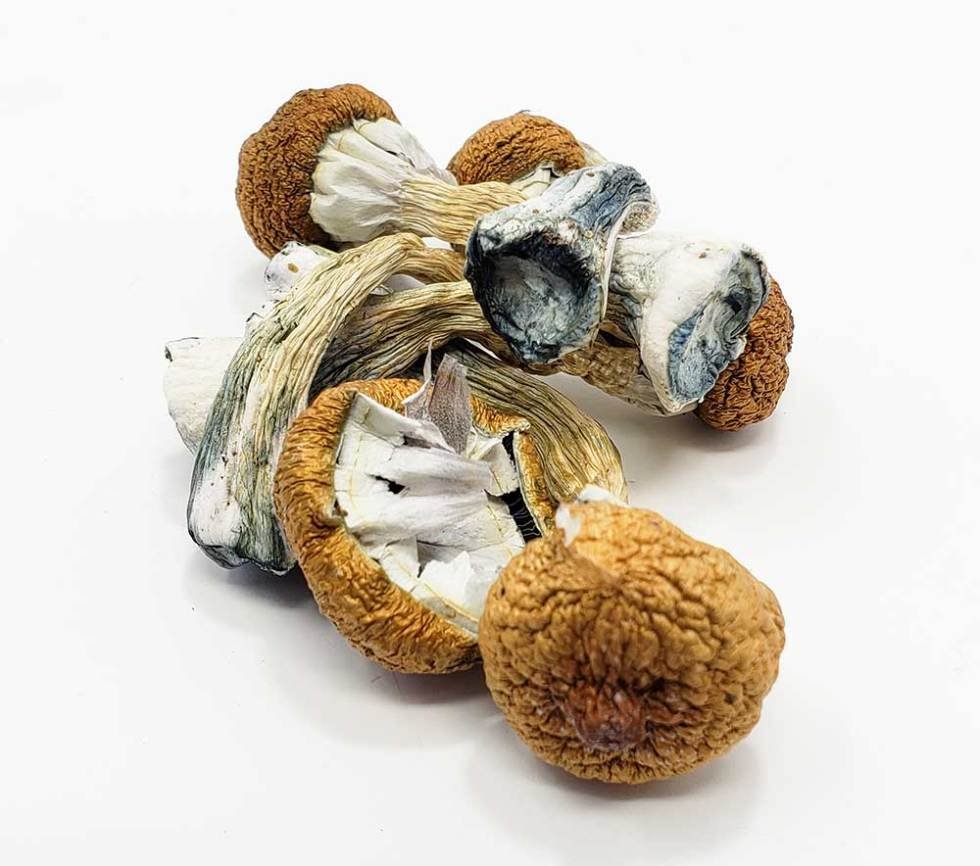
Blue Meanie Mushrooms – Ultra-Potent Psilocybe Cubensis Strain
Price range: $180.00 through $920.00
Blue Meanie Mushrooms are a powerful psilocybin strain known for their intense visuals, deep introspection, and strong body-mind effects. Organically cultivated, lab-tested, and legally sold by a licensed psychedelic supplier.
Blue Meanie Mushrooms: Potency, ID & Taxonomy Guide
Blue Meanie mushrooms is a common name used for two taxonomically distinct fungi: Panaeolus cyanescens, a wild psilocybin-containing species also historically called Copelandia cyanescens, and a Psilocybe cubensis cultivar marketed under the same name. Both bruise blue when tissue is damaged, both contain psilocybin and psilocin, and both are controlled under U.S. federal law. Because the name applies to organisms with meaningfully different morphologies, alkaloid profiles, spore characteristics, and taxonomic positions, accurate identification requires knowing which fungus is actually under discussion.
Panaeolus cyanescens, commonly abbreviated as Pan Cyan, is the species most frequently associated with the Blue Meanie name in mycological literature. The Psilocybe cubensis Blue Meanie cultivar is a separately developed strain within a widely cultivated species and should not be conflated with P. cyanescens when comparing potency, morphology, or taxonomy.
Quick Comparison: Panaeolus cyanescens vs Psilocybe cubensis Blue Meanie
The easiest taxonomic distinction between the two Blue Meanies is that Panaeolus cyanescens is a species, whereas the Blue Meanie cubensis strain is a named cultivar of Psilocybe cubensis. P. cyanescens produces black spores; P. cubensis produces dark purplish-brown spores. Their reported alkaloid profiles also differ substantially.
| Feature | Panaeolus cyanescens | Psilocybe cubensis Blue Meanie cultivar |
|---|---|---|
| Taxonomic rank | Species | Cultivar within a species |
| Modern family | Panaeolaceae | Hymenogastraceae |
| Former classification | Copelandia cyanescens | Previously placed in Strophariaceae |
| Spore print color | Black to jet-black | Dark purplish-brown |
| Cap size | 1.5–4 cm, pale gray to buff | 2–8 cm, golden-brown to tan |
| Stem | Slender, fibrous | Thicker, more robust |
| Ecology | Coprophilous, tropical/subtropical pastures | Coprophilous, warm environments; widely cultivated |
| Relative alkaloid content | Frequently reported as elevated | Moderate to moderately elevated within cubensis |
What Are Blue Meanie Mushrooms?
Blue Meanie mushrooms refers to two different fungi: Panaeolus cyanescens, also historically called Copelandia cyanescens, and a Psilocybe cubensis cultivar marketed as Blue Meanie. P. cyanescens is a separate species with black spores and slender fruiting bodies. The P. cubensis Blue Meanie cultivar has dark purplish-brown spores and typical cubensis morphology.
Panaeolus cyanescens is a coprophilous species with a cosmopolitan distribution across tropical and subtropical regions including Hawaii, Australia, Southeast Asia, the Caribbean, and parts of Africa and South America. Psilocybe cubensis is among the most widely distributed and extensively cultivated psilocybin-containing species in the world, and the Blue Meanie cultivar is one of many named strains developed within it.
Blue Meanie Mushroom Identification
Reliable identification of any mushroom requires evaluating multiple characteristics together. No single feature, including blue bruising, is sufficient on its own. Higher-confidence morphological identification considers cap and stem structure, gill characteristics, spore print color, habitat, and ecology. DNA sequencing can resolve ambiguities that microscopy alone cannot.
Cap (Pileus) and Stem (Stipe)
Panaeolus cyanescens produces a small pale cap, or pileus, typically 1.5 to 4 centimeters in diameter. The surface is pale gray to buff, often hygrophanous, meaning it shifts in appearance as moisture content changes, and may crack in dry conditions. The stipe is thin and fibrous.
The P. cubensis Blue Meanie cultivar has a pileus ranging from 2 to 8 centimeters in diameter. Young caps are conical to convex, maturing to broadly umbonate or plane, and typically golden-brown to tan in color. The stipe is thicker and more substantial, bearing an annulus where the partial veil once attached.
Gills (Lamellae)
The lamellae of Panaeolus cyanescens display a mottled pattern caused by asynchronous spore maturation across the gill surface. This unevenly colored appearance is a characteristic feature of the Panaeolus genus and helps distinguish it from many other genera. In P. cubensis, the lamellae are close, adnate to adnexed, and darken to purplish-gray as spores develop.
Spore Print
Taking a spore print is one of the simplest and most informative identification steps. Placing the cap lamellae-side down on white paper for several hours produces a clearly visible deposit. A black deposit supports P. cyanescens. A dark purplish-brown deposit supports P. cubensis. This difference alone is highly useful for separating the two species colloquially called Blue Meanie.
Habitat and Ecology
Panaeolus cyanescens grows on the dung of cattle, horses, and other grazing mammals in warm, humid climates, frequently appearing in subtropical and tropical pastures and agricultural fields. Psilocybe cubensis also grows on dung and nutrient-enriched soils in similar warm environments, though it is cultivated globally on a variety of substrates.
Microscopy and Molecular Identification
Under microscopy, P. cyanescens spores are lemon-shaped to ellipsoidal with a prominent germ pore. P. cubensis spores are subellipsoidal with a broad germ pore and somewhat thicker walls. Spore dimensions, wall characteristics, cystidia morphology, and basidia configuration provide higher-confidence morphological identification at the species level. For species-level certainty when morphological features are ambiguous, internal transcribed spacer sequencing of ribosomal DNA is the current standard in fungal taxonomy.
Why Blue Meanie Mushrooms Turn Blue
Blue Meanie mushrooms bruise blue after tissue damage triggers an enzymatic cascade involving psilocybin-derived compounds. Research has identified a phosphatase and laccase-type enzyme responsible for producing oxidized, coupled psilocin-derived oligomers that appear blue. Bruising intensity is not a reliable indicator of psilocybin concentration or mushroom safety.
The Biochemical Mechanism
When fungal tissue is damaged, the enzyme PsiP, a phosphatase, dephosphorylates psilocybin to produce psilocin. A second enzyme, PsiL, a laccase-type oxidase, then oxidizes psilocin-related molecules, generating reactive quinone intermediates that polymerize into blue-colored oligomeric compounds. A 2019 study published in Angewandte Chemie by Fricke and colleagues identified these blue psilocin-derived oligomers and characterized the enzymatic steps responsible, providing a molecular-level explanation of the reaction.
What Blue Bruising Does Not Indicate
Blue bruising is not a stand-alone identification or safety test. Several toxic and non-psychoactive fungi also produce color changes when damaged. Bruising intensity does not correlate consistently with psilocybin concentration. Identifying a mushroom based on bruising alone is unreliable and potentially dangerous.
Blue Meanie Mushroom Potency
Panaeolus cyanescens is frequently reported as more alkaloid-rich than typical Psilocybe cubensis, but there is no scientifically reliable universal potency multiplier. Psilocybin and psilocin concentrations vary among individual specimens, developmental stages, environments, storage conditions, and analytical methods. Laboratory analysis is required to establish the potency of any specific sample.
Blue Meanie Psilocybin Content: What Laboratory Data Show
Panaeolus cyanescens contains psilocybin, psilocin, baeocystin, and norbaeocystin. Jochen Gartz documented tryptamine alkaloids across Panaeolus and related species in peer-reviewed work published in Persoonia and related mycological journals during the 1990s, finding that some P. cyanescens specimens contained total tryptamine concentrations meaningfully above typical P. cubensis samples. More recent chemical analysis, including data compiled through community testing programs such as Erowid’s alkaloid data archive, reflects similar findings while also showing substantial specimen-to-specimen variation.
Several factors limit precise potency comparisons. Analytical results from different laboratories using different methods, different specimen ages, and different drying conditions are not directly comparable. Species-wide averages derived from a small number of analyzed specimens cannot be generalized reliably. Strain names within P. cubensis lack formal scientific standardization, so no cultivar name guarantees a consistent alkaloid profile across individual fruiting bodies from the same culture.
The P. cubensis Blue Meanie cultivar is reported by growers to produce moderately elevated psilocybin content relative to some common cubensis strains, but independent analytical data from a statistically meaningful sample size is not currently available in the peer-reviewed literature.
Aeruginascin, a tryptamine compound detected in some psilocybin-containing species, has been reported in Panaeolus species in the literature, though species-specific confirmation for P. cyanescens across multiple samples is limited, and its pharmacological role in humans is not fully established.
What Scientists Know vs. What Remains Uncertain
Better established: The identity of the enzymatic mechanism behind blue bruising, the presence of psilocybin, psilocin, baeocystin, and norbaeocystin in P. cyanescens, and the taxonomic separation between P. cyanescens and P. cubensis.
Less certain: Universal potency rankings between species or cultivars, exact alkaloid ratios applicable across all specimens, and the pharmacological significance of minor alkaloids such as aeruginascin and norbaeocystin in humans.
Blue Meanie vs Penis Envy: Strength Comparison
Panaeolus cyanescens and the P. cubensis Penis Envy cultivar cannot be assigned a universal potency ranking because alkaloid concentrations vary by specimen. P. cyanescens is often reported as highly alkaloid-rich, while Penis Envy is a P. cubensis cultivar associated with elevated psilocybin content in some analytical datasets, including data reviewed by Haze and colleagues in a 2021 Drug Testing and Analysis paper examining P. cubensis strain variation. Comparing P. cyanescens to Penis Envy involves comparing organisms from different species. Comparing the P. cubensis Blue Meanie cultivar to Penis Envy is a within-species comparison that also lacks robust controlled analytical data.
Neither a cultivar name, a species reputation, nor visual appearance can establish the alkaloid content of an individual specimen.
Blue Meanie Mushroom Spores
Spore Morphology and Research Use
Panaeolus cyanescens and Psilocybe cubensis spores are used by mycologists and taxonomists for species documentation and morphological research. According to the species descriptions in Stamets and Chilton’s foundational work Psilocybe Mushrooms and Their Allies and subsequent monographs, P. cyanescens spores are lemon-shaped to broadly ellipsoidal, typically 11 to 14 micrometers in length, thick-walled, and jet-black at maturity. P. cubensis spores are subellipsoidal, roughly 11 to 17 micrometers in length, thick-walled, with a distinct germ pore. These morphological differences are routinely used in educational microscopy and taxonomy research.
Legal Considerations for Spore Acquisition
In many U.S. states, spores of psilocybin-containing fungi may be lawfully acquired for microscopy or taxonomy research because spores generally do not contain psilocybin or psilocin. However, spore laws differ by jurisdiction and can depend on the specific conduct involved, including possession, sale, transport, and demonstrated intent. Some states have statutes that restrict spore possession regardless of intent. Researchers should consult current state statutes before ordering or possessing specimens. The legal landscape is addressed more fully in the legality section below.
Blue Meanie Mushroom Effects and Trip Duration
The subjective effects of psilocybin-containing mushrooms reflect the pharmacological activity of psilocin at serotonin 5-HT2A receptors in the brain. Controlled human psilocybin research, including studies conducted at Johns Hopkins University and New York University reviewed in Carhart-Harris and Goodwin’s 2017 Neuropsychopharmacology paper, documents perceptual alterations, changes in thought patterns, intensified emotional states, and distorted time perception following oral psilocybin administration.
Onset of effects from orally ingested psilocybin-containing material typically occurs within 20 to 60 minutes in controlled research settings. Primary effects generally last 4 to 6 hours, with residual effects sometimes extending an additional 1 to 2 hours. These figures are derived from controlled studies using measured psilocybin doses and may differ in real-world conditions depending on individual metabolism, stomach contents, and the variable alkaloid content of any given mushroom specimen.
Because Panaeolus cyanescens may contain higher total alkaloid concentrations than a comparable dry weight of P. cubensis, the effective biological dose per gram of dried material can differ substantially between the two species. This difference is clinically relevant and underscores the importance of accurate species identification.
Side Effects and Risks
Adverse effects documented in the clinical and pharmacological literature include nausea, anxiety, disorientation, elevated heart rate, and psychological distress. Individuals with a personal or family history of psychotic disorders face heightened risk of serious adverse psychological reactions, as noted by the National Institute on Drug Abuse. Physically dangerous activities should be avoided during any period of impairment.
The Substance Abuse and Mental Health Services Administration and Poison Control centers provide resources for individuals experiencing adverse reactions. The national Poison Control helpline in the United States is 1-800-222-1222.
Are Blue Meanie Mushrooms Legal?
Psilocybin and psilocin remain Schedule I controlled substances under the Controlled Substances Act, enforced by the Drug Enforcement Administration. This classification applies nationwide regardless of state or local policies. Possession, distribution, and manufacture of psilocybin-containing fungi are federal offenses under this framework.
State-Level Regulated Access Programs
Oregon and Colorado have established distinct regulated frameworks that do not repeal federal prohibition but create state-supervised pathways for specific psilocybin-related conduct.
Oregon’s Measure 109, passed in 2020 and administered by the Oregon Health Authority, established Oregon Psilocybin Services, a licensed framework for supervised psilocybin sessions delivered by trained facilitators at approved service centers.
Colorado’s Proposition 122, the Natural Medicine Health Act passed in 2022, created a state-regulated access system for certain natural medicines including psilocybin and psilocin, administered through the Colorado Department of Public Health and Environment.
Municipal Decriminalization
Several cities, including Denver, Colorado, Oakland and Santa Cruz in California, and Ann Arbor, Michigan, have adopted decriminalization measures or lowest-enforcement-priority policies for personal possession of psilocybin mushrooms. These local measures do not legalize possession under state or federal law.
Are Blue Meanie Spores Legal in the United States?
Blue Meanie spores may be lawful to possess for microscopy or taxonomy research in many U.S. jurisdictions because spores generally do not contain psilocybin or psilocin. However, laws vary significantly by state and turn on the specific conduct involved. Rather than categorically naming states with restrictions, researchers should consult their state’s controlled substances statutes directly, as rules distinguish between possession, sale, transport, species, and demonstrated intent. Current state law should be verified before acquiring specimens.
Blue Meanie Microscopy Research
Microscopy of Panaeolus cyanescens and Psilocybe cubensis spores serves legitimate scientific and educational purposes in fungal taxonomy, morphological documentation, and comparative species identification. Researchers use spore prints, wet mounts, and standard staining techniques to characterize spore dimensions, wall features, germ pore structure, basidia, and cystidia.
Comparative microscopy between P. cyanescens and P. cubensis clearly illustrates taxonomically significant morphological differences, particularly spore shape and deposit color, and supports accurate identification in research and educational contexts. For cases where morphological features are ambiguous or insufficient, internal transcribed spacer sequencing of ribosomal DNA provides species-level resolution that morphology alone cannot reliably achieve, and it represents the current standard in professional fungal taxonomy.
Researchers engaged in fungal taxonomy and microscopy should maintain accurate records of specimen origin, morphological observations, and any analytical data, consistent with scientific documentation standards and applicable law.
Frequently Asked Questions
Are Blue Meanie mushrooms Panaeolus cyanescens or Psilocybe cubensis?
The name refers to both. Panaeolus cyanescens is a distinct species commonly called Blue Meanie, while Blue Meanie is also the commercial name of a Psilocybe cubensis cultivar. They differ in taxonomy, morphology, spore color, ecology, and typical alkaloid profiles. P. cyanescens produces black spores; P. cubensis produces dark purplish-brown spores.
How potent are Blue Meanie mushrooms?
Panaeolus cyanescens, the Pan Cyan Blue Meanie, is frequently reported as more alkaloid-rich than typical Psilocybe cubensis. However, potency varies substantially between specimens depending on genetics, environment, developmental stage, storage conditions, and analytical method. No universal potency multiplier can be reliably applied, and laboratory analysis is the only way to establish the alkaloid content of a specific sample.
Are Blue Meanies stronger than Penis Envy?
Panaeolus cyanescens and the Penis Envy cultivar of P. cubensis cannot be assigned a universal potency ranking because alkaloid concentrations vary by individual specimen. P. cyanescens is often highly alkaloid-rich, while Penis Envy is associated with elevated psilocybin content among cubensis cultivars in some analytical datasets. The P. cubensis Blue Meanie cultivar is a separate comparison from Pan Cyan, involving a within-species comparison that also lacks robust controlled data.
Why do Blue Meanie mushrooms turn blue?
Tissue damage triggers an enzymatic cascade in which the phosphatase PsiP dephosphorylates psilocybin to produce psilocin, and the laccase-type oxidase PsiL then oxidizes psilocin-related molecules into blue-colored oligomeric compounds. This mechanism was characterized in a 2019 study in Angewandte Chemie. Bruising intensity is not a reliable measure of psilocybin concentration or mushroom safety.
What color are Blue Meanie mushroom spores?
Panaeolus cyanescens produces a black to jet-black spore deposit. Psilocybe cubensis produces a dark purplish-brown spore deposit. Spore print color is one of the most useful macroscopic features for distinguishing the two fungi that share the Blue Meanie name.
Are Blue Meanie mushrooms legal in the United States?
Psilocybin and psilocin are Schedule I controlled substances under U.S. federal law, making possession, distribution, and manufacture of psilocybin-containing fungi federal offenses. Oregon and Colorado have established state-regulated access frameworks, and some municipalities have adopted decriminalization policies. None of these state or local measures repeal federal prohibition.
Are Blue Meanie spores legal for microscopy?
Spore laws vary by jurisdiction. Psilocybin mushroom spores may be lawful to possess for microscopy or taxonomy research in many states because they generally do not contain psilocybin or psilocin. Applicable rules can differ based on possession, sale, transport, and intent. Researchers should verify current state statutes before acquiring specimens.
Can blue bruising identify a Blue Meanie mushroom?
No. Blue bruising is not a stand-alone identification or safety test. Reliable fungal identification requires evaluating pileus and stipe morphology, lamellae characteristics, spore print color, ecology, and where needed, microscopy or molecular analysis. Several toxic fungi also produce tissue color changes, and bruising intensity does not correlate consistently with psilocybin content.
51 reviews for Blue Meanie Mushrooms – Ultra-Potent Psilocybe Cubensis Strain
Add a review
Related products
Price range: $180.00 through $885.00
This product has multiple variants. The options may be chosen on the product page 
Price range: $185.00 through $920.00
This product has multiple variants. The options may be chosen on the product page 
MAGIC MUSHROOMS
Price range: $175.00 through $850.00
This product has multiple variants. The options may be chosen on the product page 
MAGIC MUSHROOMS
Price range: $185.00 through $930.00
This product has multiple variants. The options may be chosen on the product page 
Price range: $180.00 through $910.00
This product has multiple variants. The options may be chosen on the product page 
Price range: $178.00 through $865.00
This product has multiple variants. The options may be chosen on the product page 
MAGIC MUSHROOMS
Price range: $178.00 through $840.00
This product has multiple variants. The options may be chosen on the product page 
Price range: $190.00 through $890.00
This product has multiple variants. The options may be chosen on the product page
Amari Blackwell (verified owner) –
No synthetic feeling—just pure nature.
Adeline Burke –
I felt emotionally safe using this, and that matters deeply with a product like this.
Alondra Shields (verified owner) –
I’ve tried many sources, but this one truly feels professional and cared for.
Celine Bateman (verified owner) –
Was nervous at first, but everything went perfectly.
Anika Lockhart (verified owner) –
Felt held by something bigger than me.
Lena McFadden (verified owner) –
No synthetic feeling—just pure nature.
Ella Cox (verified owner) –
You’re not just buying a product here — you’re entering a process that’s treated with integrity.
Olivia Carter (verified owner) –
I didn’t think something so small could have such a big emotional impact. I’m still in awe.
Julia Parker (verified owner) –
This helped me rewrite some inner scripts I didn’t know I was still carrying. The professionalism made me feel safe enough to go there.
Mckenzie Wiley (verified owner) –
I’ve waited years for something like this — safe, sacred, and available when I was ready.
Gerald Tate (verified owner) –
There’s a soft professionalism here that sets the tone before anything even begins. It’s comforting.
Charles Richardson (verified owner) –
There’s something powerful about knowing your experience matters to the people providing it. That’s exactly how I felt here.
Zola Darnell (verified owner) –
The best balance of visuals, warmth, and inner clarity I’ve experienced.
Hadley Shields (verified owner) –
Gentle but mind-opening.
Hunter Butler (verified owner) –
Everything about this product invites presence, and everything about the service invites trust.
Samuel Simmons (verified owner) –
From shipping to set and setting, the whole thing was flawless. I felt truly taken care of.
Ariana Griffin (verified owner) –
Every part of this process felt like a whisper of reassurance. I was never alone in this.
Jordan Rogers (verified owner) –
I felt more like a person than a customer. That meant more to me than I expected.
Brecken Flood (verified owner) –
I was able to forgive myself.
Nehemiah Finnegan (verified owner) –
Helped with deep emotional trauma.
Aria McCray (verified owner) –
I faced myself—and it was exactly what I needed.
Nathan Phillips (verified owner) –
This product helped me unpack so much mentally — and knowing it came from a reliable, discreet source made all the difference.
Armani Devine (verified owner) –
A great dose for personal growth.
Neil Dennis (verified owner) –
This gave me emotional insight, and the professionalism behind the product gave me peace of mind.
Bryan Patterson (verified owner) –
This isn’t just about the trip — it’s about feeling safe, informed, and respected along the way. That’s exactly what I got here.
Rachel Lewis (verified owner) –
I’ve tried different sources in the past, but none gave me this level of emotional depth and trust.
Jordan Rogers (verified owner) –
The come-up was smooth and warm, like slipping into a deep meditation.
David Smith (verified owner) –
This was handled like a wellness experience, not just a transaction. I appreciate that more than I can say.
Logan Evans (verified owner) –
Really pleased with how everything turned out.
Maria Hughes (verified owner) –
This helped me feel connected to the world again in a way I didn’t know I needed. It was like waking up from a long emotional fog.
Joel Graham (verified owner) –
The delivery was fast and discreet, which helped me focus fully on the experience itself.
Lillian Cross (verified owner) –
I feel more grounded, more creative, and more alive since using this.
Clara Jenkins (verified owner) –
A straightforward and satisfying experience.
Matthew Wilson (verified owner) –
Everything arrived in great condition.
Zachary Carter (verified owner) –
Everything was handled professionally from start to finish.
Isla Henderson (verified owner) –
The service was professional and reliable.
Frank Butler (verified owner) –
The whole process exceeded my expectations.
Alex Peterson (verified owner) –
Everything was exactly what I expected.
Scarlett Lewis (verified owner) –
A smooth experience from start to finish.
Vanessa McDonald (verified owner) –
Really impressed with the attention to detail.
Hunter Bailey (verified owner) –
Had a very pleasant purchasing experience.
Thomas Jenkins (verified owner) –
Everything went perfectly from beginning to end.
Claire Phillips (verified owner) –
Simple, efficient, and professionally handled.
Hailey Wood (verified owner) –
Really pleased with the service provided.
Anna Edwards (verified owner) –
Very pleased with how efficiently everything went.
Nova Stewart (verified owner) –
Everything went perfectly from beginning to end.
Autumn Sanders (verified owner) –
Everything worked out perfectly.
Ronald Hughes (verified owner) –
Couldn’t ask for a smoother process.
Stephanie Hamilton (verified owner) –
A professional and straightforward experience.
Emma Williams (verified owner) –
Really happy with my overall experience.
Bobby Owens (verified owner) –
Everything was exactly as described.